
How to Find Will County Court Dockets
Will County court dockets are reached through two official tools run by the Clerk of the Circuit Court, Andrea Lynn Chasteen. The first is the court schedule gateway. It posts daily and weekly calendars by court date and courtroom. The second is the iPublic case lookup. It returns the docket entries on a specific case file. Both tools sit behind a short public access disclaimer that the user must agree to before going further.
The Circuit Clerk publishes the court schedule gateway at the public court schedules page. From there, the user picks a date and court type, then opens the schedule PDF for that day. The Circuit Clerk states that the schedule is provided as a service and that case participants remain responsible for knowing when they must appear.
The iPublic tool reached through the Circuit Clerk Public Access page is the route to case-level dockets. The Clerk warns that the online tool is a limited version of the case-management data and is not the official court record. Document images are not in iPublic. To view a filed motion, order, or transcript, the user orders a copy through the i2File process or visits a public terminal at the courthouse. Felony, misdemeanor, traffic, civil, family, probate, and chancery cases all flow through the same Will County court dockets system.
The Circuit Clerk lookup portal is shown below. The case lookup tool is the link reached after the public access disclaimer.
The lookup screen for the Twelfth Judicial Circuit is shown in the iPublic case lookup portal screenshot below.
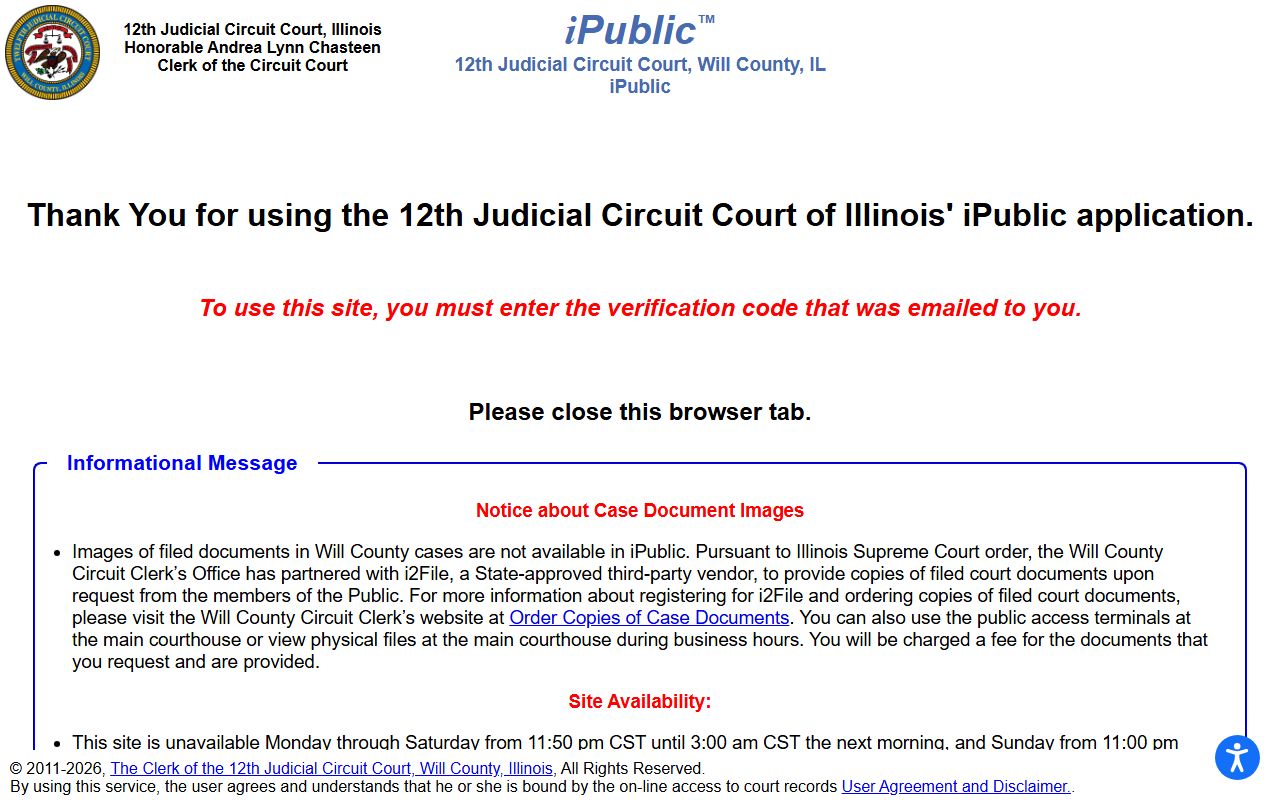
The portal opens after the user reads the disclaimer and enters the verification code emailed by the Circuit Clerk. From there a name or case number returns the docket for that file.
Will County Court Calendar and Schedule Pages
Will County court dockets are split into two public schedule pages. The first is the public court schedules page. It carries the daily case calendars set by the court for the main courthouse and the branch courts. The second is the municipality court schedules page. It carries the dockets set for local police agencies that file in Will County, with one PDF per agency per court date.
Both pages publish the schedules as PDFs. The user picks a date, opens the PDF, and scrolls to the courtroom and judge for the matter. The Circuit Clerk states that the public must know when to appear, so the schedules are best read the day before and again the morning of court. Schedules change when judges issue continuances, so a calendar pulled a week early may not match the final list.
The public schedule page is shown below. The case lookup link on that page goes to iPublic for case-level docket entries.
The list of daily schedule PDFs and the case lookup link appear on the Will County public court schedule page.
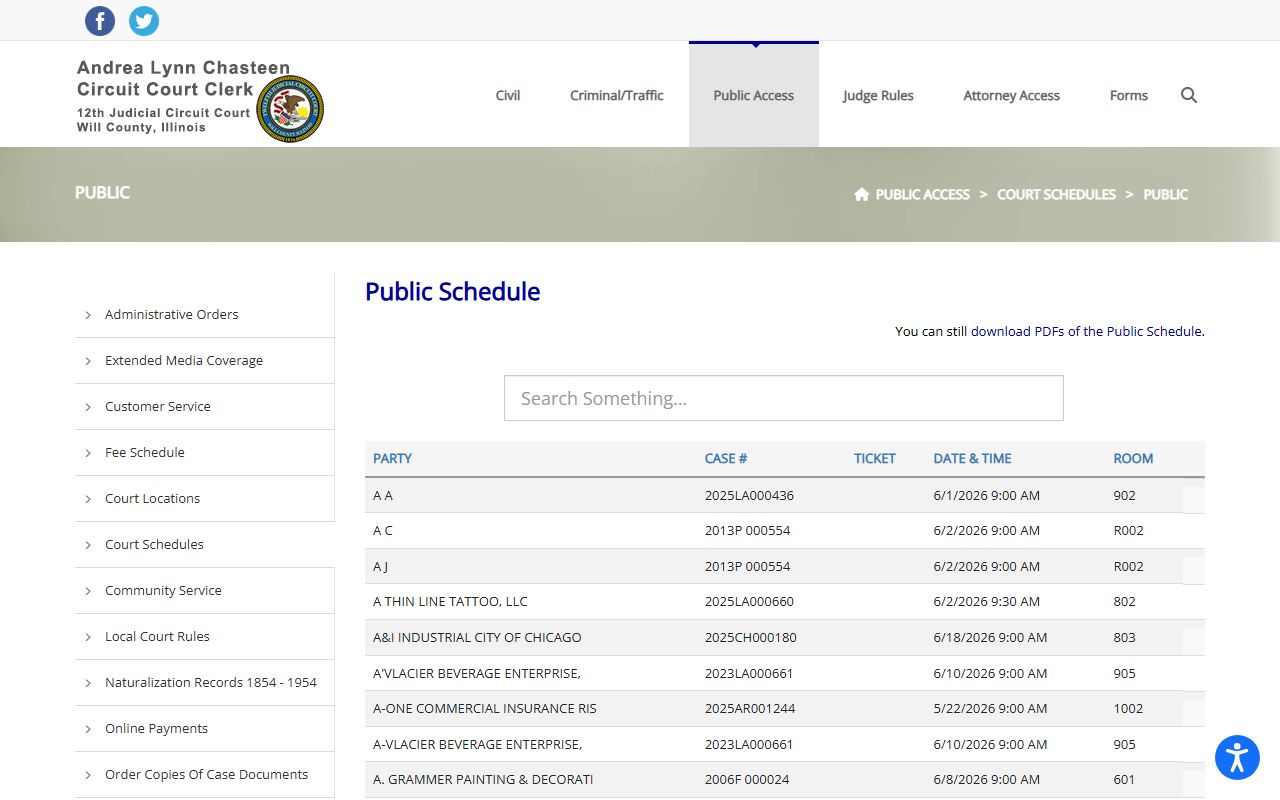
The page sits inside the Public Access section of the Circuit Clerk site. The municipality page sits next to it and serves the local police dockets.
The local agency schedule page is shown below. It is the source for branch court dockets that involve municipal police filings.
The municipal docket index runs from the Will County municipality court schedule page.
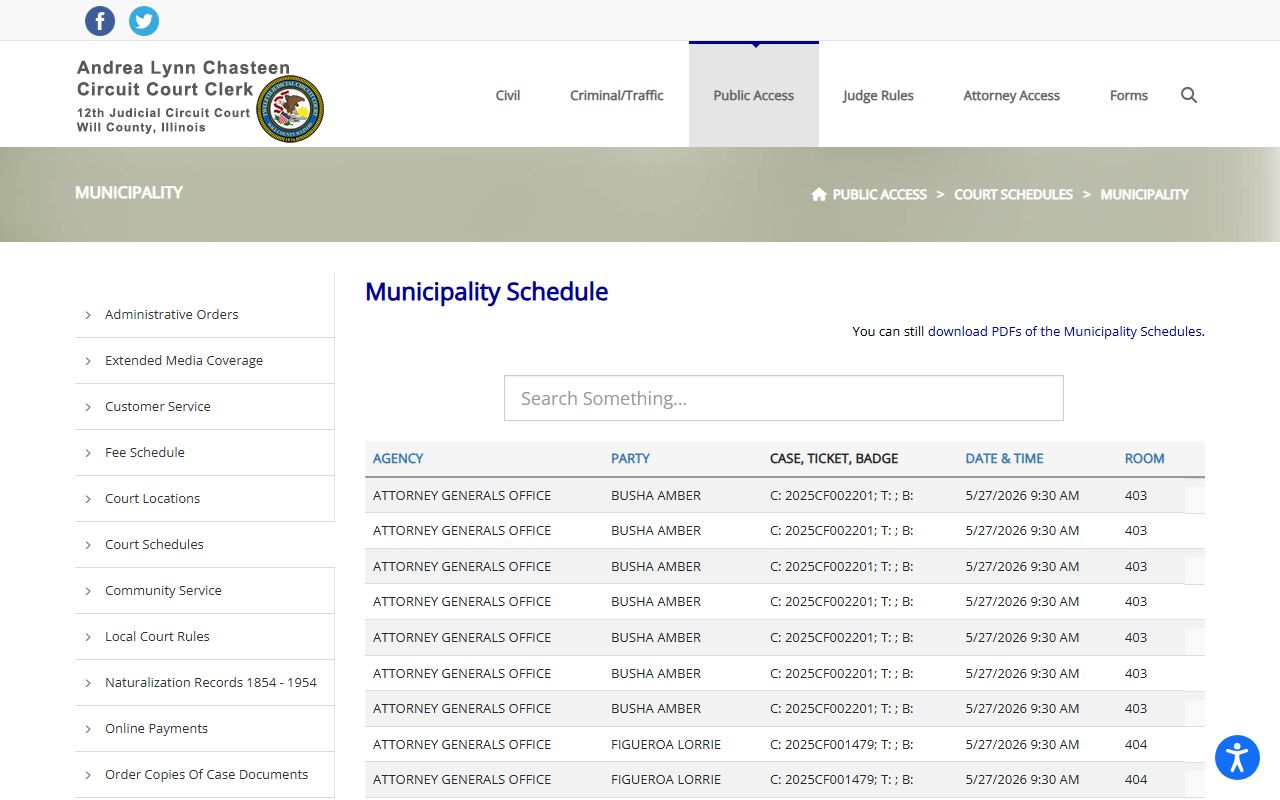
The municipal page is most useful for traffic and local misdemeanor cases brought by police outside the Will County Sheriff.
Courtroom Assignments in Will County
Will County court dockets are read alongside the courtroom assignment list posted by the Twelfth Judicial Circuit. The list pairs each judge with a room and a case category. Some rooms split misdemeanors by the last name of the defendant. Others handle a single subject area such as traffic, first appearance, mental health, or mediation. The list below mirrors the assignments shown on the 12th Judicial Circuit homepage at the time of research.
| Judge | Room | Case Type |
|---|---|---|
| J. Harvey | 101 | Traffic |
| Pavich | 201 | Local Misdemeanor |
| Ewanic | 202 | First Appearance |
| Tisdale | 301 | Misdemeanor Last Name L-Q |
| Hale | 302 | Misdemeanor Last Name F-K |
| Safford | 303 | Misdemeanor Last Name A-E |
| DeWilkins | 304 | Misdemeanor Last Name R-Z |
| Harvey | 401 | Criminal Felony / Mental Health |
| Connor | 403 | Criminal Felony |
| Cornelius | 404 | Criminal Felony |
| Bertani-Tomczak | 405 | Criminal Felony |
| Mediation | 440 | Mediation |
| Jones | 501 | Criminal Felony |
| Colon-Sayre | 502 | Criminal Felony |
| Smigielski | 503 | Criminal Felony |
The room number is the fastest way to use a schedule. Once the user knows the case type and the defendant last name, the assignment table points to the right courtroom and the matching docket. The list shifts when a judge is reassigned, so a fresh check against the 12th Judicial Circuit site is wise before a trip to court.
Felony, Misdemeanor, and Traffic Floors
The Will County courthouse stacks its criminal floors in a clear way, and the Circuit Clerk explains the layout on the DUI Information page. Traffic court sits on the first floor in Room 101. Misdemeanor courts run on the second and third floors, broken out by the first letter of the defendant last name. Criminal felony courts run on the fourth and fifth floors.
DUI cases follow the same map. The Circuit Clerk states that misdemeanor DUI cases use DT or CV case designations and are heard on the third floor. Felony DUI cases use the CF designation and are heard on the fourth floor. Other CF felony files are split across courtrooms on the fourth and fifth floors. A docket entry that lists Room 401, 403, 404, or 405 means a felony floor on level four. Room 501, 502, or 503 means a felony floor on level five.
Note: A DT or CV docket number points to the third floor, while a CF docket number points to the fourth or fifth floor.
Holiday Court
Will County also runs a Holiday Court for matters that cannot wait until the next business day. Local court rules set Holiday Court for Saturdays and holidays at 9:00 a.m. The rule limits the docket to four matters. Those four are bail hearings, Saturday weddings performed by a judge, emergency orders of protection, and emergency injunctive relief.
The Sheriff and other police agencies bring qualifying in-custody arrestees to Holiday Court, and the rule allows video arraignment equipment for the bail call. Anyone seeking an emergency order of protection on a Saturday or holiday should go to the main courthouse at 9:00 a.m. The Holiday Court judge is set by the Chief Judge through a posted rotation.
Holiday Court is not the place for a normal continuance, a status check, or a routine traffic appearance. Those wait for the next regular court day, and the regular court date appears on the standard Will County court dockets.
Case Participants' Responsibility
The Circuit Clerk states on the public schedule page that the court schedule is offered as a service and that the responsibility for knowing when one must appear in court rests with the case participant. The line is repeated on the Public Access disclaimer. The point is plain. A missed date is on the party, not on the website.
If a court date cannot be confirmed online, the next step is a call to the Circuit Clerk at 815-727-8592. The Clerk can read the docket entry for the file and confirm the next setting. Defense lawyers and pro se litigants both rely on the docket to track continuances. If a docket entry shows a vacated hearing or a new date, that entry controls.
People who get a paper notice in the mail should match the notice to the online docket and the schedule page. The three should line up. If they do not, call the Clerk before the court date. Bench warrants and default judgments often start with a missed appearance, so a five-minute check the day before saves a much larger problem.
What a Docket Entry Shows
A Will County docket entry is a short, dated line that records one event in a case. The entries stack in order from the day the case was filed to the most recent court action. Read together, they tell the story of the file. Read one at a time, each line answers a single question: what happened, who did it, and what comes next.
| Field | What It Shows |
|---|---|
| Filing date | The date the entry was added to the docket, used to track timing and deadlines. |
| Event type | Filing, summons issued, return of service, motion, order, continuance, hearing scheduled, judgment, sentence, or notice of appeal. |
| Parties | Plaintiff and defendant, petitioner and respondent, or state and defendant, depending on the case type. |
| Order or disposition | The judge's ruling on a motion, the outcome on a charge, the judgment amount, or the sentence terms. |
| Next setting | The next court date, the courtroom, and the judge for the upcoming hearing. |
Document images for the underlying motion, order, or transcript are not in iPublic. The docket line tells the user that the document exists. To read the document, the user orders a copy through i2File or visits a public terminal at the courthouse. The same rule applies to bond paperwork, charging documents, plea forms, and judgments.
Common Docket Terms
Will County court dockets use short legal terms that can confuse a first-time reader. The short glossary below covers the words that show up the most.
- Continuance
- A postponement of a scheduled court date to a later setting.
- Disposition
- The outcome of a case or a charge, such as guilty, not guilty, dismissed, or set for trial.
- Arraignment
- The criminal hearing where the defendant is told the charges and enters a plea.
- First Appearance
- The first time the defendant comes before a judge after an arrest, often in Room 202.
- Status
- A short hearing to update the judge on the state of the case and set the next step.
- Motion
- A written request asking the judge to take some action in the case.
- Order
- The judge's written command or ruling on a motion or other matter.
- Judgment
- The final or enforceable court decision that resolves a claim or charge.
Will County also uses short case codes on the docket. CF means criminal felony. CM means misdemeanor. TR means traffic. DT means DUI traffic. P means probate. D means dissolution. MR means miscellaneous remedy.
Remote and Zoom Court
The Twelfth Judicial Circuit uses remote and Zoom links for some matters, and the court posts the Zoom information in administrative orders rather than on the open docket itself. Civil status calls, family case management dates, and certain motions are still set by the judge for remote video appearance. Each judge controls the rule for the courtroom.
Traffic court is now the clearest in-person example. The Circuit Clerk states on the traffic citation page that, as of September 7, 2021, traffic cases are heard at court facilities and Zoom is no longer an option unless a judge approves it. A defendant on a traffic ticket should plan for an in-person setting unless an order in the file says otherwise.
Note: A docket line that lists a Zoom or video link still means the case is set, and a missed remote setting is treated the same as a missed in-person appearance.
Ordering a Certified Docket Copy
A printed copy of a Will County docket sheet, or of any single docket entry, is ordered from the Circuit Clerk. The standard route is the order copies of case documents page. The Clerk uses i2File, the same state-approved vendor that handles e-filing in Illinois. The user registers with i2File, requests the copy, and pays online when the request is fulfilled. The Clerk says copies are usually uploaded in about two business days, and the requester gets an email when the file is ready.
The cost is set by the Circuit Clerk fee schedule. The first page is $2.00. Pages two through twenty are $0.50 each. Each page after that is $0.25. A certification page, used when a court needs a sealed copy for a hearing or for a transfer between courts, is $6.00 per document. A petitioner on an order of protection pays $0.00 for the order copies under the same schedule.
Note: An uncertified online copy is fine for review, but a certified copy is what courts and most agencies will accept as proof.
The Circuit Clerk fee schedule landing page is shown below.
The full schedule is downloaded from the Will County Circuit Clerk fee schedule page.
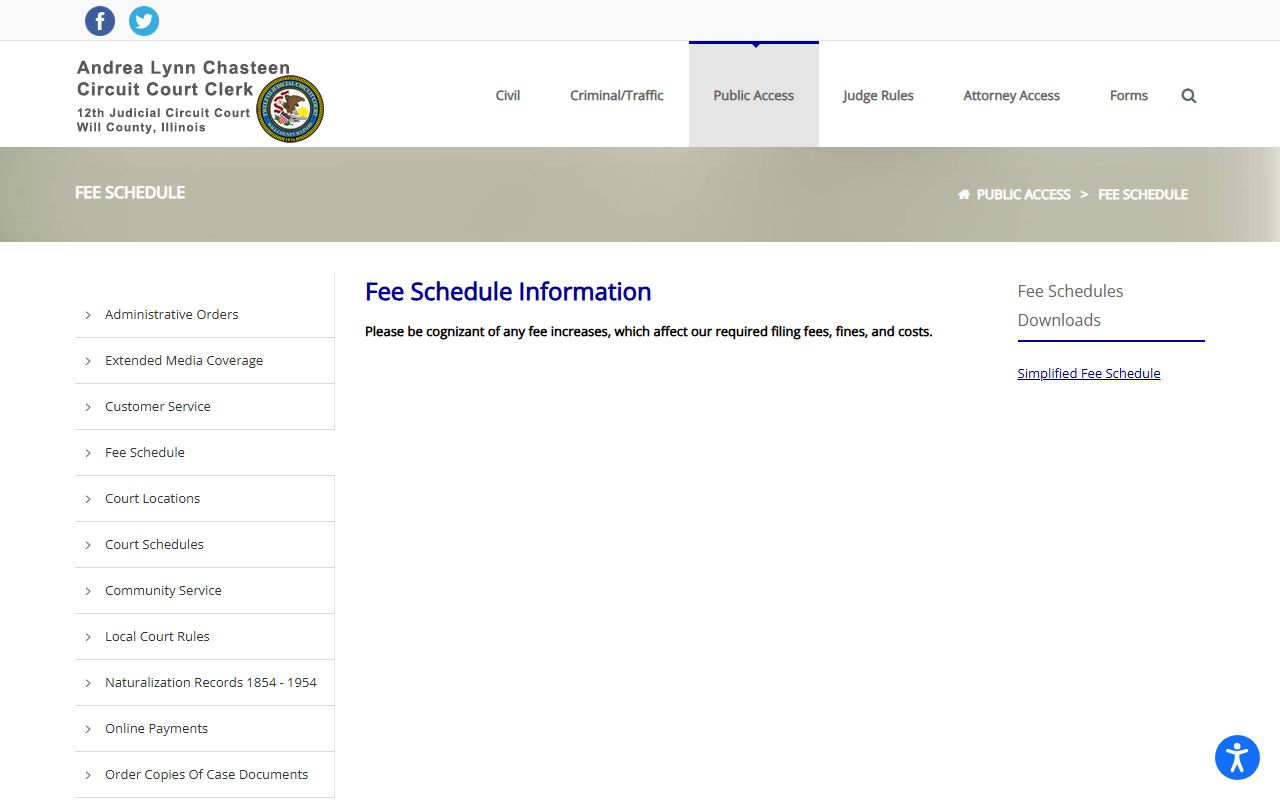
The simplified fee schedule PDF on that page lists every copy, certification, and case-type filing fee in one place.